Infection Prevention and Control
Vaccines and infection prevention advice for patients and visitors.
Recommended Vaccines During Pregnancy
The following links will open the HSE website on recommended vaccines during pregnancy:
- Flu Vaccine for Pregnant Women
- Whooping Cough (Pertussis) Vaccine for Pregnant Women
- Pregnancy, breastfeeding and fertility: COVID-19 vaccination
- After pregnancy: Rubella and Pregnancy (if not immune or to complete MMR vaccination)
Infection Control for Patients and Visitors
For you (patients)
- Clean your hands – especially before eating and after using the toilet. Sinks and hand rub are available, and this helps protect you and your baby from infection.
- Reduce clutter – keep belongings in lockers and bring only essentials to help keep the ward clean.
- Feel free to ask – all staff follow hand hygiene, but you can always ask if they’ve cleaned their hands before caring for you or your baby.
- Wear slippers – this helps keep your feet clean and prevents bacteria spreading to your bed. Please report any dirt or mess, and let staff know if dressings, wounds or drips become sore or loose.
For your visitors
- Stay away if unwell – visitors should be symptom-free for at least two days, especially after vomiting, diarrhoea, fever, cold or cough.
- Follow visiting times – this allows staff time to carry out important infection-control measures.
- Limit visitors – no more than two people at a time, to reduce infection risk. Visitors should clean their hands on arrival and leaving, and avoid sitting on beds.
- Use public toilets – not patient bathrooms, and always wash and dry hands thoroughly.
These simple steps help keep you, your baby and everyone around you safe.
Hand Hygiene
At The National Maternity Hospital, keeping you and your baby safe from infection is a top priority. We’ve made significant progress in recent years, and the risk of infection in hospital is very low – but good practices still matter.
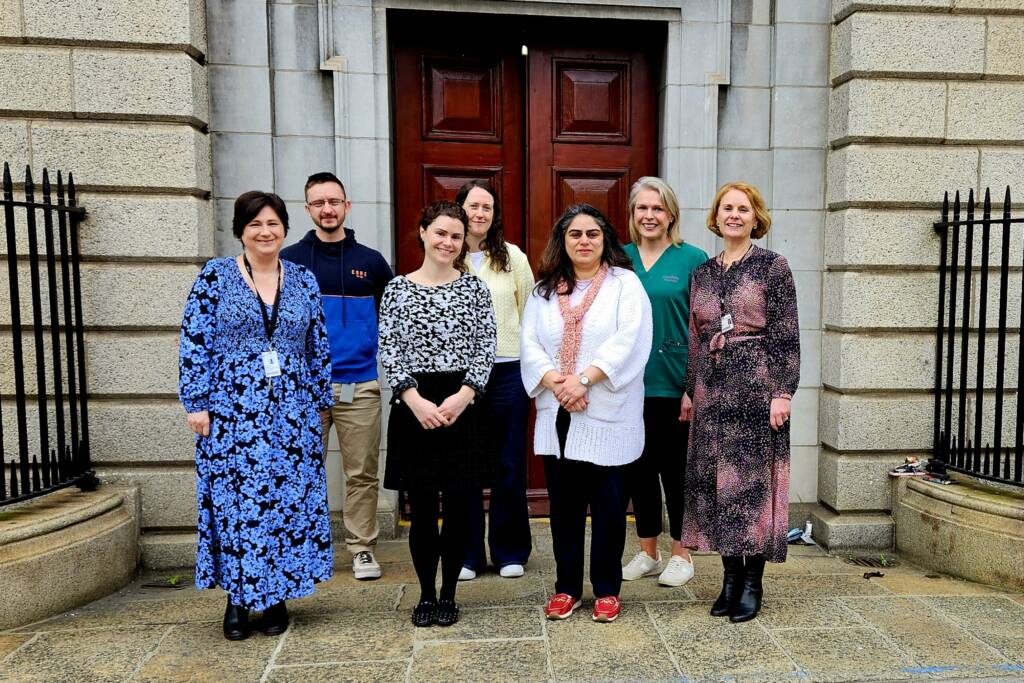
Our dedicated Infection Control team – including a Microbiology Consultant, Infection Control Specialists and a Surveillance Scientist – works closely with nurses and midwives across all areas to support safe care.
We’re here to guide and support you, but infection prevention is something we all share – staff, patients and visitors alike.
Our work focuses on:
- Education for staff, patients and visitors
- Monitoring infection rates through audit and surveillance
- Maintaining high standards of hospital hygiene
- Developing policies, procedures and expert guidance
- Managing and responding to outbreaks
Together, these measures help keep everyone safe during your stay.
Information on Vaccines and Infections
AI and IPCT Research Project Summary
Key Messages
- AI can produce simple, readable, and coherent patient information leaflets rapidly. However, it is not suitable without human evaluation and input.
- NMH leaflets had higher mean scores for accuracy, safety, completeness and actionability, while AI scored higher for understandability, human-centred tone and fairness/inclusion. No domain remained statistically significant after correction for multiple comparisons.
- AI-generated patient information requires substantial specialist clinical input, multidisciplinary review and approval before use.
Access the project poster here.
Access the full project summary here.
Understanding Pyrexia in Labour
Risk Factors Associated with Pyrexia in Labour: A Systematic Review and Meta-analysis
Key Messages
- A systematic review of 13 observational studies identified several maternal and intrapartum factors associated with pyrexia in labour (PIL), defined as maternal temperature ≥38°C.
- Epidural analgesia demonstrated the strongest and most consistent association with PIL. Nulliparity, induction of labour, and longer labour and membrane rupture durations were also associated with PIL, although substantial variation between studies was observed for several factors.
- The findings highlight the complexity of PIL and the need for further research to identify independent predictors and distinguish infectious from non-infectious causes. This evidence will inform future research into clinical prediction tools.
PROSPERO registration: CRD420251141429
Access the project poster here.
Contact
Shideh Kiafar and Bronwyn Redmond, Infection Control Specialists
Phone
skiafar@nmh.ie / bronwyn.redmond@nmh.ie